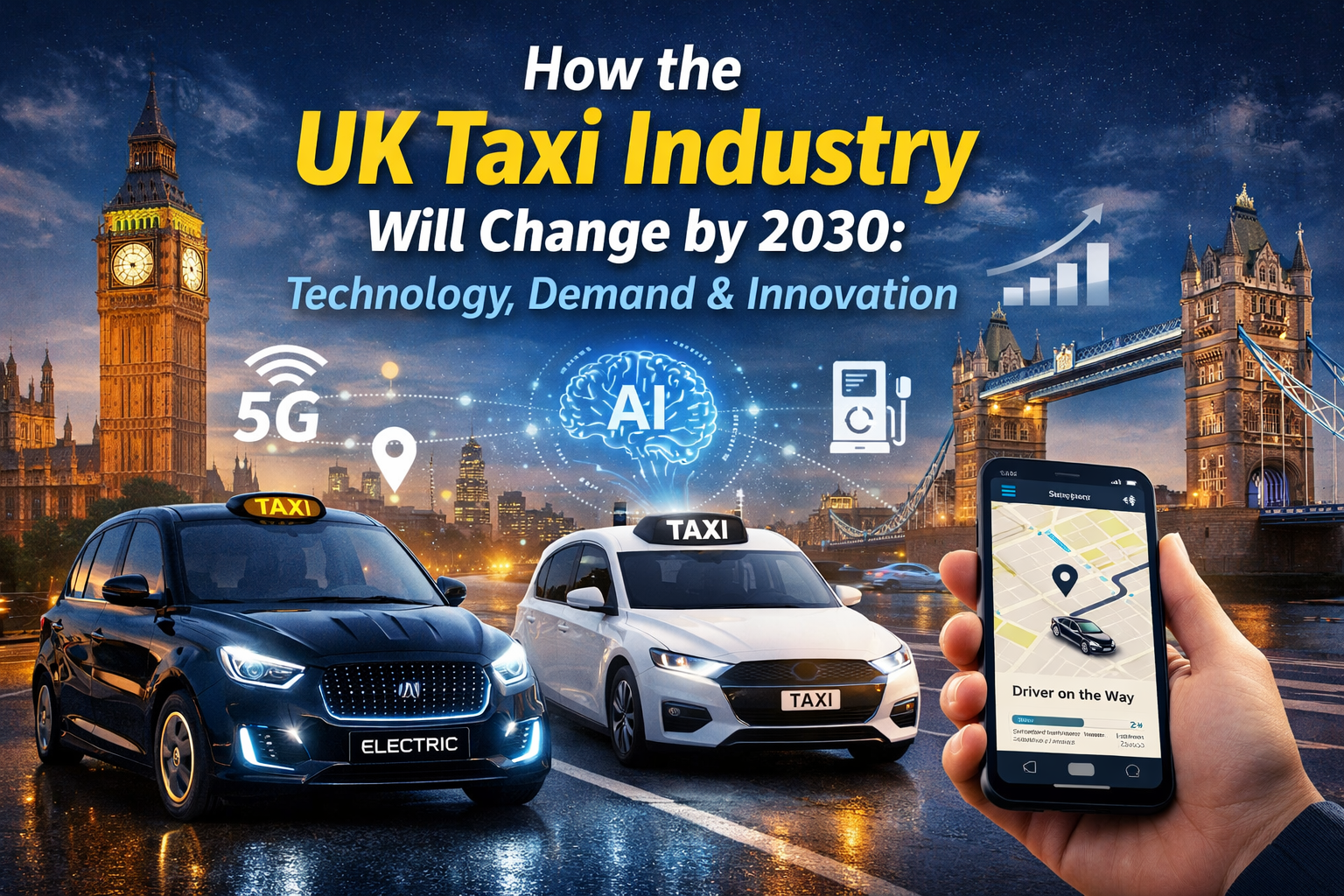
Future of Taxi Industry in the UK (2026–2030): Electric Fleets, Smarter Booking, and the Next Phase of Private Hire
The UK taxi industry is moving into one of its most important transition periods. Between 2026 and 2030, the sector is expected to change through cleaner vehicles, stronger digital systems, updated regulation, and rising customer expectations around speed, reliability, safety, and visibility. Traditional private hire is no longer judged only on whether a passenger reaches the destination. It is now judged on the full journey experience, including booking ease, live communication, route efficiency, comfort, and service consistency.
This shift is especially relevant in London and other major UK cities where transport demand is constant and passengers regularly move between airports, stations, hotels, homes, offices, and event venues. The future of the taxi market will not be shaped by one single innovation. Instead, it will be influenced by several connected developments working together, including electric vehicles, smarter dispatch, app-based booking, tighter operating standards, and more informed customer choice.
For travellers who regularly depend on direct London airport transfer services, the future matters because timing, luggage handling, and route control remain essential parts of a smooth journey. Public transport is improving, but many passengers still want a pre-booked vehicle that can collect them directly and take them exactly where they need to go without extra changes or uncertainty.
This guide looks at where the UK taxi industry is heading from 2026 to 2030, what changes are likely to affect drivers and operators, and why strong private hire brands still have a major role to play. It also explains how services linked to accommodation, rail, cruise, and city movement will continue to matter in a more connected transport environment.
Quick Navigation
- Why the UK Taxi Industry Is Entering a New Phase
- Electric Vehicles and Greener Fleets
- Digital Booking, Apps, and Smarter Dispatch
- How Passenger Expectations Are Changing
- Regulation, Safety, and Operator Standards
- Automation, AI, and the Human Driver Role
- Airport, Hotel, Port, and Station Travel Demand
- Main Challenges Facing Operators and Drivers
- What the Industry May Look Like by 2030
- Final Thoughts
Why the UK Taxi Industry Is Entering a New Phase
The years ahead are likely to reshape the taxi industry more than any recent period. The old model of simply taking bookings by phone and assigning the nearest available vehicle is being replaced by a much wider service system. Customers now expect instant confirmations, clearer pricing, live driver updates, and flexible booking methods. Operators also face pressure to modernise because passengers compare every travel experience against other digital services they already use in daily life.
A large part of this change comes from how people travel now. Journeys are often mixed and multi-stage. A customer may land at an airport, move to a hotel, travel to a meeting, return to a rail station, and later book an evening ride to another destination. That means private hire is increasingly expected to fit into a wider mobility picture rather than operate as an isolated service.
At the same time, the public sector is pushing transport toward cleaner operations, better accountability, and greater passenger protection. This creates both pressure and opportunity for operators. Businesses that adapt well can build trust, improve service quality, and stay competitive through the rest of the decade.
Figure 1: What Is Driving Taxi Industry Change in the UK
The result is a market that will likely become more efficient, more transparent, and more specialised. Operators that understand this wider transition will be in a much better position to grow between 2026 and 2030.
Electric Vehicles and Greener Fleets
One of the biggest visible changes will be the continued move toward electric and low-emission vehicles. Environmental policy is already shaping fleet decisions, especially in London where clean-air measures and operating costs make vehicle choice a major business issue. For private hire companies, electric vehicles are no longer a future concept. They are becoming part of daily planning, investment, and long-term competitiveness.
The appeal of electric vehicles is clear. They can reduce fuel costs, lower emissions, support compliance with urban regulations, and offer a quieter ride. For passengers, that can improve comfort. For operators, it can strengthen brand perception and show commitment to a more modern service model.
However, the transition is not simple. Vehicle purchase costs remain a challenge for some drivers and operators, and charging infrastructure still affects flexibility in certain areas. This means the market will not shift overnight. More likely, 2026 to 2030 will be a mixed period where electric, hybrid, and conventional vehicles continue to operate side by side while the balance gradually changes.
Operators that plan fleet renewal carefully will be in a stronger position to meet future regulation without disrupting service standards. That is especially important in airport and long-distance work where timing, luggage space, and dependable availability still matter as much as emissions targets.
Digital Booking, Apps, and Smarter Dispatch
Digital booking will continue to define how the taxi industry develops. Many passengers now prefer booking through mobile-friendly systems because they want speed, clear confirmation, and less friction. This does not mean phone bookings will disappear, but it does mean the best operators will increasingly provide both convenience and flexibility through stronger digital tools.
Smarter dispatch systems are also becoming central to how operators manage performance. Good dispatch is no longer only about sending a driver quickly. It is about matching the right vehicle to the right job, considering traffic, timing, journey type, and customer needs. In future, the operators that use these tools well will often deliver a better experience without needing to increase complexity for the passenger.
The same digital development supports direct hotel transfers where guests want easy pre-booking, accurate pickup timing, and dependable coordination between accommodation and onward travel. For many visitors, convenience begins long before they enter the vehicle. It starts with how simple the booking process feels.
Figure 2: What Strong Digital Taxi Operations Improve
Over time, passengers will treat this level of convenience as normal. That means digital maturity will not be a bonus feature by 2030. It will be part of the expected standard.
How Passenger Expectations Are Changing
Customer expectations are shifting in ways that affect every part of the industry. Price still matters, but passengers increasingly judge value through reliability, communication, safety, comfort, and timing accuracy. A cheaper journey is not always seen as better if the booking process is unclear, the driver update is poor, or the pickup creates stress.
Passengers also expect greater transparency. They want to know what has been booked, when the vehicle is likely to arrive, how the trip will be managed, and what level of service they can expect. This is especially true for business passengers, families, first-time visitors, and anyone dealing with luggage or time-sensitive schedules.
Personalisation is likely to become more important too. Some customers value executive travel, others need family-friendly space, and many simply want consistency. The operators that understand different travel contexts and present their services clearly will stand out more strongly than those offering generic transport only.
| Passenger Expectation | Why It Matters | Industry Response | Likely Impact by 2030 |
|---|---|---|---|
| Reliable Timing | Passengers plan around meetings, flights, and events | Better dispatch and route monitoring | Higher service expectations |
| Clear Booking | Less confusion improves trust | Digital confirmations and organised communication | Standard customer requirement |
| Comfort | Travel quality affects overall experience | Better vehicle choice and cleaner interiors | Stronger brand differentiation |
| Transparency | Passengers want more certainty | Visible booking details and journey updates | Greater operator accountability |
The future taxi market will therefore reward operators that think beyond the basic ride and focus on the full customer journey from booking to drop-off.
Regulation, Safety, and Operator Standards
Regulation will remain one of the strongest influences on how the industry develops. Local authorities and licensing bodies continue to place emphasis on safety, record keeping, driver suitability, operational standards, and public confidence. That means successful operators will not only need strong service quality, but also strong compliance systems behind the scenes.
This matters because a modern taxi business depends on trust. Passengers want reassurance that the vehicle, the driver, and the booking process are all managed professionally. For operators, that means documentation, booking controls, complaints handling, and monitoring processes are not just administrative tasks. They are part of the customer experience even when passengers never see them directly.
The next few years will likely bring even more attention to accountability, especially as technology becomes more involved in transport. Whether the issue is data handling, route oversight, digital payments, or vehicle monitoring, regulatory expectations are unlikely to become lighter. Businesses that build solid foundations early will find it easier to adapt.
As a result, future growth in the industry is likely to favour operators that combine modern technology with dependable standards rather than relying on one without the other.
Automation, AI, and the Human Driver Role
Artificial intelligence and automation will influence the industry more through operations than through sudden full replacement of human drivers. AI can support route suggestions, demand forecasting, job allocation, and performance monitoring. These tools can make businesses more efficient and help reduce wasted time, but they do not remove the importance of real-world service judgement.
The idea of autonomous taxis receives a lot of attention, but the likely path from 2026 to 2030 is gradual and limited rather than total. The UK may see more trials, more discussion, and more technical development, yet many everyday journeys still depend on human interaction, practical judgement, and flexible decision-making. This is especially true for complex pickups, airport work, assisted travel, hotel coordination, and journeys where unexpected problems need calm handling.
Human drivers therefore remain central to the passenger experience. Professional conduct, local awareness, route judgement, and customer interaction still shape how a journey feels. Technology can support these strengths, but it does not easily replace them in the kinds of travel that matter most to many private hire users.
Figure 3: How Technology and Human Service Are Likely to Coexist
The future therefore looks more like assisted operations than total automation. The best businesses will likely combine intelligent systems with professional drivers rather than treating them as opposites.
Airport, Hotel, Port, and Station Travel Demand
Future demand in the UK taxi sector will continue to be strongly influenced by transport connection journeys. These are the trips where private hire solves a practical problem that public transport does not always solve comfortably. Customers often want direct, timed, door-to-door service when moving between major entry points and final destinations.
That remains true for passengers needing seaport transfers and station transfers because these trips often involve luggage, uncertain arrival timing, and the need to reach hotels, homes, or business venues without multiple route changes. A connected transport system is useful, but direct private hire often provides the most practical final stage.
The same applies to visitors, tourists, and business travellers moving through London and other busy urban areas. Large stations, cruise terminals, and airports generate ongoing demand for operators that can manage timing carefully and deliver smooth onward travel. From 2026 to 2030, this part of the market is likely to remain one of the strongest areas for professional private hire.
Growth in tourism, event travel, university movement, and short-stay accommodation also supports this demand. While commuter patterns may continue to change, connection-based travel is likely to stay highly relevant because it depends on convenience and predictability rather than routine alone.
Main Challenges Facing Operators and Drivers
Although the future includes opportunity, it also includes pressure. Rising costs remain one of the biggest issues facing drivers and operators. Insurance, maintenance, vehicle replacement, compliance requirements, and technology investment all affect margins. Businesses therefore need to improve efficiency without lowering service quality.
Driver recruitment and retention may also remain difficult in some areas. The job demands professionalism, flexible hours, route awareness, and customer service under pressure. If costs rise faster than earnings or working conditions become less attractive, operators may find it harder to maintain a stable driver network.
Competition continues to matter as well. Passengers can now compare more services quickly, so operators need stronger presentation, clearer value, and better customer retention. Businesses that fail to modernise may struggle, but those that modernise without maintaining reliability may also lose trust.
- Managing rising operating costs while keeping pricing competitive
- Balancing environmental targets with realistic fleet affordability
- Maintaining compliance as rules and expectations evolve
- Keeping customer communication clear across different booking channels
- Retaining experienced drivers in a changing market
- Using technology well without making the service feel impersonal
These challenges do not mean the industry is weakening. They mean the market is becoming more demanding and more professional. The businesses that respond carefully can still grow strongly during this period.
What the Industry May Look Like by 2030
By 2030, the UK taxi industry will probably look more advanced, more accountable, and more segmented. Passengers are likely to see more electric vehicles, more digital booking systems, more operational visibility, and stronger expectations around service standards. Operators will likely rely more on data and smarter dispatch, while still depending on human drivers for many journey types.
The market may also separate more clearly into different service categories. Some customers will focus on low-cost convenience, while others will prioritise reliability, direct travel, executive comfort, airport coordination, or specialist route support. This creates room for well-positioned operators to stand out through service quality rather than competing only on price.
Private hire will remain especially valuable where public transport is less convenient, where time matters more, or where comfort and direct routing make the overall journey easier. That means airport work, station collections, family travel, visitor transport, and hotel-based movement are all likely to remain important parts of the sector.
| Industry Area | Likely Direction by 2030 | Main Benefit | Main Risk |
|---|---|---|---|
| Fleet Mix | More electric and hybrid vehicles | Cleaner operations | Upfront investment pressure |
| Booking Systems | More digital-first management | Faster and clearer service | Poor implementation can frustrate users |
| Regulation | Stronger compliance focus | Greater trust and safety | Higher admin burden |
| Customer Demand | More tailored service expectations | Better market positioning | Harder to satisfy every segment |
Overall, the future is likely to reward operators that are organised, adaptable, and clear about the kind of service they provide. Growth will not come only from being available. It will come from being dependable in the moments that matter most to passengers.
Final Thoughts
The future of the taxi industry in the UK between 2026 and 2030 looks less like disruption for its own sake and more like a steady movement toward cleaner fleets, stronger digital systems, higher standards, and smarter service delivery. The market is changing, but the need for dependable private hire is not disappearing. It is becoming more specialised and more closely linked to real passenger needs.
For travellers who want direct pickups, timely journeys, better coordination, and professional service from booking to drop-off, LTR Minicab remains well placed in a market where reliability still matters as much as innovation. As public transport and private hire continue to evolve side by side, the strongest operators will be those that combine practical service, modern systems, and clear customer confidence.