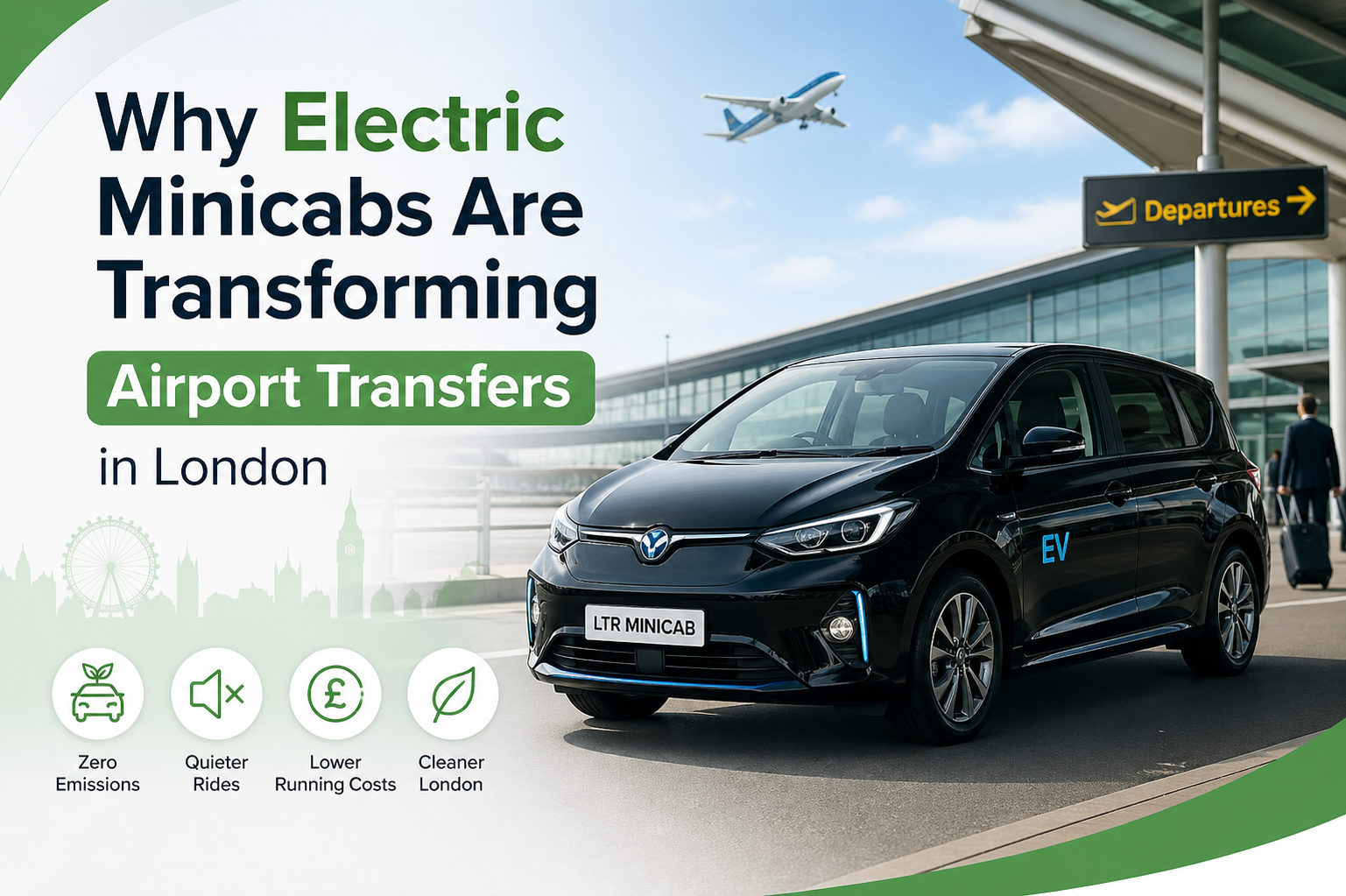
Electric Airport Transfers: Smarter, Cleaner, and More Reliable Travel
Electric minicabs are becoming one of the biggest talking points in the UK private hire industry. As passengers look for cleaner, quieter, and more reliable travel, airport transfer companies are starting to rethink how their fleets should operate in the coming years. The traditional petrol or diesel minicab is not disappearing overnight, but the direction of travel is clear: electric vehicles are becoming a major part of modern airport transport.
Airport transfers are especially important in this change because they involve fixed routes, planned bookings, luggage space, time-sensitive pickups, and high customer expectations. Whether a passenger is travelling from Heathrow to Central London, Gatwick to a hotel, or Stansted to a business meeting, the journey needs to be smooth, professional, and dependable. Electric minicabs can support this demand by offering lower emissions, quieter journeys, and better long-term operating efficiency.
For travellers booking direct airport transfers, the future of electric minicabs matters because it affects comfort, pricing, availability, sustainability, and service quality. As charging networks grow and vehicle technology improves, electric private hire vehicles are likely to become a normal part of airport travel across London and the wider UK.
This guide explains whether electric minicabs are truly the future of airport transfers, what benefits they bring, what challenges still exist, and how modern operators can prepare for the next stage of private hire transport.
Quick Navigation
- Why Electric Minicabs Are Gaining Attention
- Why Airport Transfers Suit Electric Vehicles
- Passenger Benefits of Electric Minicabs
- Fleet Efficiency and Operating Costs
- Charging, Range, and Real-World Challenges
- Electric Minicabs Beyond Airport Transfers
- Electric vs Traditional Minicabs
- What the Future May Look Like
- Final Thoughts
Why Electric Minicabs Are Gaining Attention
Electric minicabs are gaining attention because the transport industry is under pressure to become cleaner, smarter, and more cost-efficient. Cities are focusing more on air quality, passengers are becoming more environmentally aware, and private hire operators are looking for vehicles that can reduce long-term running costs. This combination makes electric vehicles a natural option for the next generation of minicab services.
In London, where airport transfers, hotel pickups, business travel, and long-distance journeys happen every day, cleaner vehicles can offer a strong advantage. Electric minicabs produce no tailpipe emissions, which makes them better suited to urban areas where congestion and pollution remain major concerns. For passengers, this creates a more responsible way to travel without losing the convenience of door-to-door service.
The private hire market is also becoming more competitive. Customers now expect professional drivers, easy booking, clear pricing, and comfortable vehicles. Electric minicabs support this modern image because they are quiet, smooth, and often fitted with newer technology. They help operators present a forward-thinking service while improving the overall travel experience.
Key Reasons Electric Minicabs Are Growing
This does not mean every minicab will become electric immediately. The transition depends on vehicle cost, charging access, journey distance, and operator planning. However, the movement toward electric fleets is already shaping how airport transfer companies think about the future.
Why Airport Transfers Suit Electric Vehicles
Airport transfers are one of the best use cases for electric minicabs because most journeys are pre-booked. A planned booking gives the operator time to assign the right vehicle, check driver availability, monitor flight timing, and prepare for the route. This makes electric vehicle planning easier than random street-based taxi work.
Airport routes are also more predictable than many short city journeys. Operators often know the most common routes between Heathrow, Gatwick, Luton, Stansted, London City Airport, hotels, homes, and business districts. This helps with battery planning, charging schedules, and vehicle allocation.
For example, a passenger arriving at Heathrow may need a direct ride into Central London, while another customer may need a transfer from a hotel to Gatwick. These journeys can be managed more efficiently when the booking is confirmed in advance and the operator understands the distance, timing, and luggage needs.
Electric minicabs are also useful for professional travel because many airport passengers value comfort after a long flight. A quieter ride can make the journey feel more relaxed, especially for families, tourists, business travellers, and passengers arriving early in the morning or late at night.
This is why electric vehicles are likely to become a growing part of services connected to airports, hotels, rail stations, cruise ports, and city travel.
Passenger Benefits of Electric Minicabs
For passengers, the biggest benefit of an electric minicab is the quality of the ride. Electric vehicles are quiet, smooth, and comfortable, which can make a major difference after a tiring journey. There is no loud engine noise, less vibration, and a calmer cabin environment.
This is especially valuable for airport transfers because passengers may be tired, carrying luggage, travelling with children, or heading directly to a meeting. A comfortable minicab journey can help reduce travel stress and create a better first impression of the destination.
Electric minicabs also support cleaner travel choices. Many passengers now care about the environmental impact of their journeys, especially business travellers and international visitors. Choosing a cleaner vehicle for an airport transfer allows them to reduce their travel footprint while still enjoying private hire convenience.
Another benefit is that electric vehicles are often newer models. This can mean better interiors, improved safety features, more advanced navigation, and a more premium feel. When combined with professional service, electric minicabs can help raise the standard of airport transfers.
| Passenger Need | How Electric Minicabs Help | Why It Matters for Airport Transfers | Future Impact |
|---|---|---|---|
| Comfort | Quiet cabin and smooth acceleration | Useful after long flights and early arrivals | Higher customer satisfaction |
| Clean Travel | No tailpipe emissions during the journey | Supports eco-conscious airport passengers | Stronger demand for EV options |
| Modern Vehicles | Newer interiors and improved technology | Better experience for business and family travel | Improved brand trust |
| Reliability | Planned journeys allow better vehicle allocation | Important for flights, luggage, and timing | More efficient airport operations |
For passengers comparing private hire options, these benefits can make electric minicabs feel like a natural upgrade from older traditional vehicles.
Fleet Efficiency and Operating Costs
For operators, electric minicabs are attractive because they can reduce running costs over time. Electricity is often cheaper than petrol or diesel, and electric vehicles generally have fewer moving parts. This can reduce servicing needs and help operators manage long-term vehicle expenses more effectively.
Fleet efficiency is especially important for airport transfer companies because vehicles may cover long distances every day. Regular airport routes can create high mileage, which makes fuel cost and maintenance a major business concern. If managed well, electric vehicles can reduce these costs while improving service quality.
A modern ltr minicab fleet needs to balance comfort, luggage space, reliability, and cost control. Electric vehicles can support this balance, but they must be chosen carefully. Not every EV is suitable for every route, especially when passengers have multiple suitcases or need long-distance transfers.
The best fleet strategy is not simply to buy electric vehicles quickly. It is to match the right vehicle to the right service. Airport work may need larger EVs, executive EVs, or hybrid options depending on route length, passenger count, and luggage requirements.
How Electric Minicabs Can Improve Fleet Efficiency
By 2030, more operators are likely to treat electric fleet planning as a core business decision rather than a luxury upgrade.
Charging, Range, and Real-World Challenges
Despite the benefits, electric minicabs still face practical challenges. The biggest concern is charging. A petrol or diesel vehicle can refuel quickly, but electric vehicles need charging time. For busy airport transfer operators, this must be planned carefully to avoid delays and downtime.
Range is another important issue. Many modern electric vehicles can handle typical London airport transfer routes, but longer journeys require more planning. Operators need to consider traffic, weather, passenger load, luggage weight, and whether the driver will have enough battery for the next booking.
Charging infrastructure is improving, but availability can still vary by area. Fast chargers may be busy during peak times, and not every driver has access to convenient home charging. This means the success of electric minicabs depends not only on the vehicle but also on the charging network around it.
There is also the issue of upfront cost. Electric vehicles can be more expensive to buy, which can be difficult for small operators or independent drivers. Although long-term savings may help, the initial investment remains a real barrier.
| Challenge | Why It Matters | Possible Solution | Airport Transfer Impact |
|---|---|---|---|
| Charging Time | Vehicles cannot work while charging | Use planned booking gaps and rapid chargers | Requires better scheduling |
| Driving Range | Long journeys need battery confidence | Match EVs to suitable routes | Important for distance-based bookings |
| Vehicle Cost | EVs can cost more upfront | Plan gradual fleet renewal | Transition may take time |
| Charger Access | Not all areas have equal charging coverage | Build charging strategy around route demand | Affects driver availability |
These challenges do not stop electric minicabs from becoming the future, but they show why the transition must be practical, planned, and realistic.
Electric Minicabs Beyond Airport Transfers
Electric minicabs are not only useful for airport transfers. They can also support many connected travel services across London and the UK. A passenger may book an airport pickup today, a hotel transfer tomorrow, and a city journey later in the week. This makes EV fleet planning valuable across several service categories.
For visitors staying in London, direct hotel transfers remain important because travellers often want a simple journey between airports, accommodation, restaurants, offices, and attractions. Electric vehicles can make these journeys quieter and more comfortable while supporting cleaner city travel.
Cruise passengers can also benefit from cleaner private hire. Many travellers need reliable seaport transfers between London, Southampton, Portsmouth, Dover, Tilbury, and other port locations. These journeys often involve luggage and fixed departure times, making planned private hire a practical option.
Students are another key passenger group. A student minicab london service can help with university moves, airport arrivals, luggage transfers, and safe late-night journeys. Electric vehicles can support this market by offering comfortable and responsible travel for students and families.
Electric minicabs may also work well for day hire bookings, especially when passengers need a vehicle for meetings, shopping, sightseeing, hospital visits, or multiple stops. With proper charging and route planning, EVs can support full-day travel while reducing emissions in busy city areas.
Services That Can Benefit from Electric Minicabs
This wider use shows why electric minicabs are not just a small airport trend. They are part of a bigger shift toward cleaner private hire across many travel needs.
Electric vs Traditional Minicabs
When comparing electric minicabs with traditional petrol or diesel minicabs, the difference is not only environmental. The vehicles also differ in operating style, customer experience, maintenance needs, and long-term business value. Traditional vehicles still have advantages in refuelling speed and long-distance flexibility, but electric vehicles are improving quickly.
| Comparison Area | Traditional Minicab | Electric Minicab | Best Use Case |
|---|---|---|---|
| Fuel / Energy | Petrol or diesel costs can fluctuate | Electric charging can reduce running costs | EVs suit planned repeat routes |
| Emissions | Produces tailpipe emissions | Zero tailpipe emissions | EVs suit city and clean-air zones |
| Ride Comfort | Engine noise and vibration vary by vehicle | Quiet and smooth ride quality | EVs suit airport and executive travel |
| Maintenance | More engine-related servicing | Fewer moving parts | EVs may lower long-term maintenance |
| Journey Planning | Refuelling is quick and flexible | Charging requires better planning | Traditional vehicles still help on very long routes |
Practical Airport Transfer Scorecard
The data-style comparison shows that electric minicabs are not perfect for every journey yet, but they are increasingly suitable for airport transfers, city journeys, hotel pickups, and scheduled private hire work.
What the Future May Look Like
The future of airport transfers is likely to be electric, but not instantly and not completely in one step. Between now and 2030, many operators may use a mixed fleet of electric, hybrid, and traditional vehicles. This allows them to serve different journey types while gradually improving sustainability.
As charging infrastructure expands, electric vehicle range improves, and vehicle prices become more competitive, more airport transfer companies will likely move toward electric fleets. Passengers may also begin to request EV options more often, especially for business travel, hotel transfers, and environmentally conscious journeys.
Technology will also support the change. Smarter booking systems can help operators assign EVs to suitable journeys, plan charging breaks, and avoid unnecessary downtime. This means the success of electric minicabs will depend on both vehicles and software.
By 2030, electric minicabs may become a normal expectation in London airport transfers. Passengers may not see them as a special feature, but simply as part of a professional, modern, and responsible transport service.
- More electric and hybrid vehicles in private hire fleets
- Better charging access around airports, hotels, and city hubs
- Smarter dispatch systems matching EVs to suitable routes
- Greater passenger demand for clean and quiet travel
- Stronger connection between airport transfers and sustainable transport
- Continued use of traditional vehicles for some long-distance or specialist journeys
The strongest operators will be those that adopt electric vehicles carefully, without sacrificing reliability, luggage space, timing, or customer service.
Final Thoughts
Electric minicabs are very likely to be a major part of the future of airport transfers. They offer cleaner travel, quieter rides, lower long-term running costs, and a more modern passenger experience. For planned airport journeys, where routes and timings can be managed in advance, electric vehicles make strong practical sense.
However, the change will be gradual. Charging access, vehicle cost, range planning, and route suitability still matter. The future will not belong only to companies that buy electric vehicles. It will belong to operators that use them wisely, maintain strong service standards, and understand what passengers need from airport travel.
For passengers looking for reliable, professional, and future-ready private hire travel, LTR Minicab remains connected to the kind of service modern travellers expect: direct booking, comfortable vehicles, airport knowledge, and dependable door-to-door journeys across London and beyond.
Electric minicabs are not just a trend. They are part of a wider movement toward smarter, cleaner, and more passenger-focused airport transfers. As technology improves and customer expectations rise, electric private hire will continue to move from future possibility to everyday reality.